Editorial standards
How One Incense writes and reviews content
A public record of who writes our pages, how claims are checked, and where our limits begin.
What a reader can expect
A real owner
One Incense Editorial identifies the One Incense publisher responsible for the page. It is an organization byline, not a pen name and not a clinician.
A visible method
Research pages name their sources. Comparison pages say when a conclusion comes from official materials instead of paid, hands-on testing.
A hard medical boundary
Our tools support focus. They do not diagnose ADHD, provide treatment, or replace care from a qualified professional.
A correction trail
Material reviews change the visible date. Volatile facts such as pricing are checked against the provider rather than copied from another comparison site.
Who is responsible
One Incense Editorial is the organizational byline for content maintained by the One Incense product owner. It means One Incense accepts publishing responsibility for the page.
It does not mean a doctor reviewed the content. Pages that have not been reviewed by a qualified clinician say so next to the byline. We will not add a clinical credential until a real reviewer has checked the named page.
How a page is made
- Start with the user jobThe page must help someone make a decision or complete an action, not merely repeat a keyword.
- Separate claim typesProduct behavior, external evidence, lived experience, and our judgment are not presented as the same thing.
- Open the sourceA search result or another summary is not enough. The linked source must support the sentence being published.
- Check the productPublished test notes identify the controls and version actually checked. Competitor facts use official materials unless a separate hands-on test is recorded.
- Review the boundaryHealth language gets a specific check for diagnosis, treatment, certainty, and whether a clinician should be the next step instead of another productivity technique.
What we have actually checked
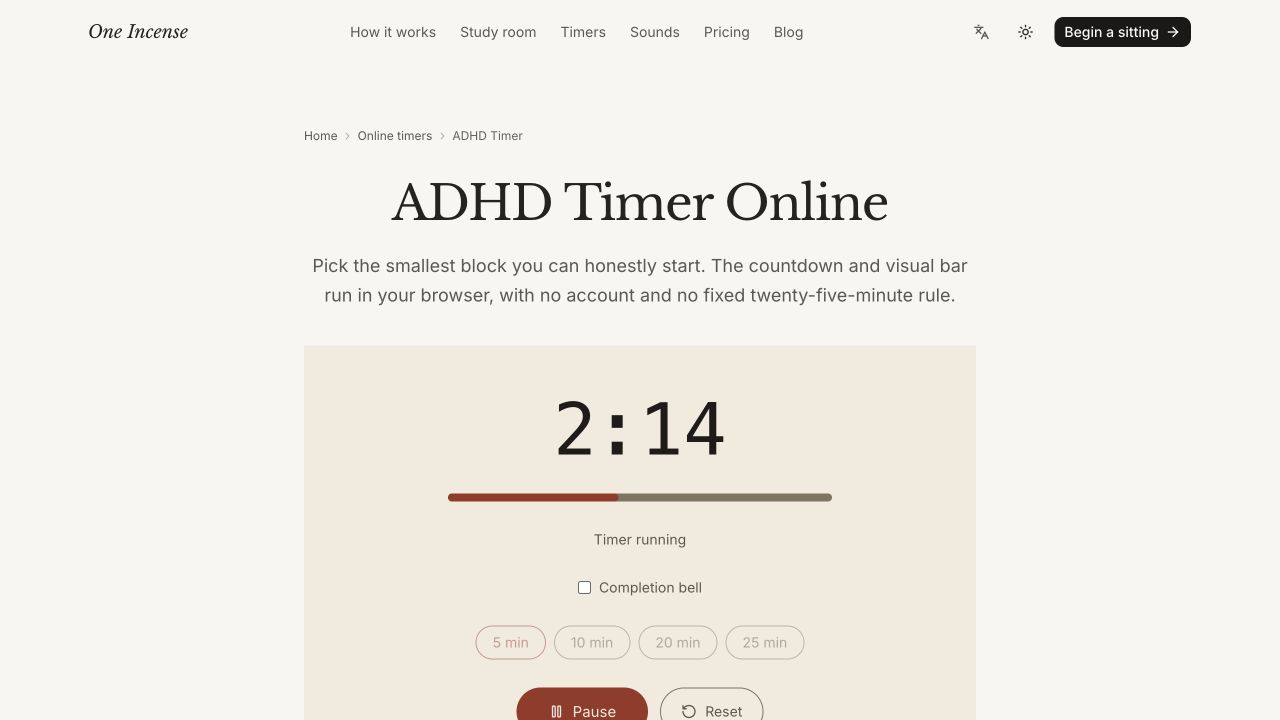
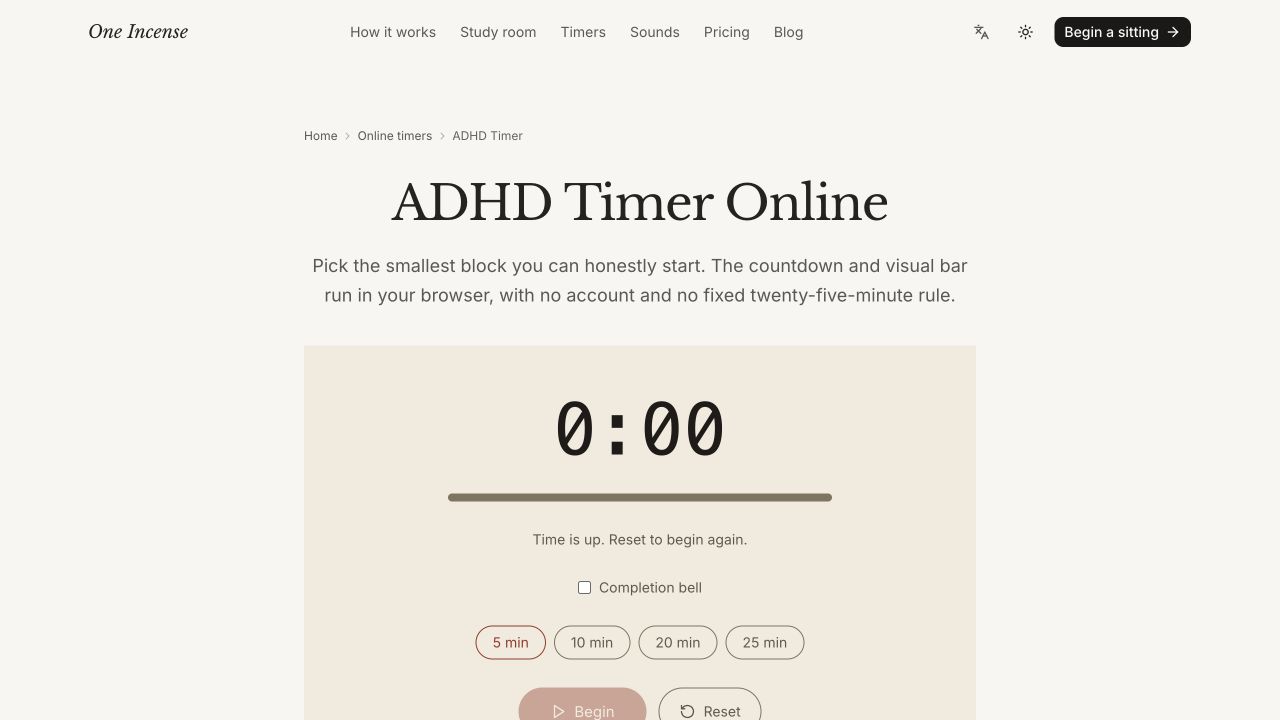
The records below describe checks of our own public tools. Browser controls and a timed session supplied the observations. No participants were recruited and no improvement in focus, task quality or ADHD symptoms was measured. These checks cover controls and displayed timer states.
Observations are dated separately from this page. The October 4 record concerns the production release published that day. A later version may behave differently; this record does not verify it.
| Date and scope | Observation | Limit |
|---|---|---|
| October 4 · public timers and private study room | Start, pause and reset checks passed. Desktop production checks used the Codex in-app browser at 1280 × 720. Separate menu and layout checks used a 390 × 844 mobile viewport. | A mobile viewport is not a test of every physical phone, background tab or device sleep state. |
| October 4 · five-minute ADHD timer | The recorded session lasted at least 318 seconds. Completion displayed 0:00 and disabled Begin. Reset restored 5:00 and enabled Begin. | The completion bell was off. Physical audio and timer accuracy during device sleep were not verified. |
| October 9 · 100 public target pages | Public responses returned successfully, with one H1, description and matching canonical. Structured data parsed and all 100 targets appeared in the sitemap. | This checks delivery and document fields. It does not establish Google indexing, ranking, reader benefit or conversion. |
What still needs a separate test
Production checkout and paid permissions, memory across days, the usefulness of AI recaps, camera and microphone behavior, and real-world focus outcomes remain outside these checks. Comparison research has not tested every competitor's paid plan. We identify these gaps where they affect a buying decision.
Try the public timer or private study room with one small task. Record what you completed yourself. Presence and activity signals cannot verify the quality of that work.
How AI is used
AI tools may assist with outlines, source discovery, wording, contradiction checks, and code. AI output is never treated as a source. A maintainer remains responsible for checking the cited page and accepting each published claim.
We do not create a fictional author, reviewer, testimonial, or first-person experience to make assisted work appear human. When the method matters, the page states what was and was not tested.